 Readspresso
What works is reading regularly, building your vocabulary, and skimming on purpose when you don't need every detail. What doesn't work is reading whole pages "at a glance", switching off the voice in your head, or any method that promises several times your speed with no loss of comprehension. That is the conclusion of a 2016 review by five reading psychologists: Keith Rayner, Elizabeth Schotter, Michael Masson, Mary Potter and Rebecca Treiman (Rayner et al., 2016). This post draws mainly on it.
How your eyes read
Your eyes don't glide along a line. They stop on a word for about 250 milliseconds, then jump on. Each jump takes 20 to 35 milliseconds, so moving the eyes accounts for only about 10% of reading time. The rest of the time your brain is recognising words and building meaning from them.
Between 10% and 15% of eye movements go back to an earlier word. That is a normal part of reading, not a fault; there is more on it in Does speed reading work?
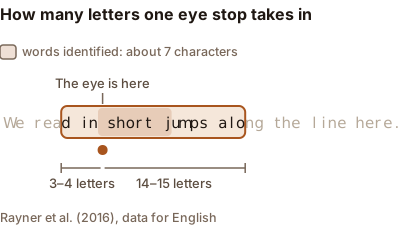
One stop takes in very little. In English, the span the eye uses while reading is 3 to 4 letter spaces to the left of where you are looking and 14 to 15 to the right. Words themselves are identified over an even shorter stretch, about 7 characters to the right: the word you are looking at and one or two after it. The eye picks up nothing from the lines above or below.
Those numbers answer the most common promises made by speed-reading courses.
Myth 1: reading a whole page with peripheral vision
Some courses teach that you can take in a whole line or page at once, out of the corner of your eye. The review's authors say plainly that this is not biologically or psychologically possible. Visual acuity is highest in a small area at the centre and drops off sharply outside it. About 3 degrees from the point of fixation, letter recognition falls to chance.
The span is set by how much language information can be taken from the text, not by physical distance. Attempts to widen it with drills that flash words in the periphery have not made people read faster with good comprehension (the review cites Brim, 1968, and Sailor and Ball, 1975).
Myth 2: you have to silence your inner voice
Speed-reading courses often present inner speech as a habit left over from school that slows you down. Research shows that silent readers naturally access the sound of words, and attempts to block that usually hurt.
In one study, people read while repeating irrelevant words aloud. Their comprehension got worse. When they tapped a rhythm with their fingers instead, comprehension held up (Daneman and Newson, 1992, as described in the review). Speech was the problem, not doing two things at once.
More on the voice in your head, and how to read faster without fighting it, in Subvocalization: should you stop reading in your head?
Myth 3: one word at a time on a screen can go as fast as you like
RSVP apps flash one word at a time in the same spot, so your eyes don't have to move. But eye movements only take about 10% of reading time, so removing them saves little. What RSVP does remove is the chance to look back at a word, and that lowers comprehension (Schotter, Tran & Rayner, 2014).
Myth 4: a course will double your speed with no loss of comprehension
One study described in the review tracked adults' eye movements before and after a speed-reading course. Before the course they read at about 280 words per minute, afterwards at about 400. They made fewer and shorter stops. Their comprehension score fell from 81% to 74% (Calef, Pieper and Coffey, 1999). They got faster and paid for it in comprehension.
The authors conclude that course graduates are in practice being taught to skim, not to read faster in the full sense. In another comparison, trained speed readers and skimmers did equally poorly on questions about details. You can't answer a question if your eyes never stopped where the answer was.
What works
Lots of reading and a bigger vocabulary. This is the review's main conclusion. Your eyes stop for less time on common words like house than on rare ones like abode. The more words you know well, the more of them you recognise at once. Practising reading is practising language.
Knowing the subject. Fast readers know enough about a topic to fit new information straight into what they already know. You will get through a text in a field you know faster than an equally long one in a new field.
Skimming on purpose. When you don't need full comprehension, skimming is an honest tool. The review describes effective ways of skimming to find specific information quickly. Just know that you are skimming, and don't mistake it for reading.
Measuring speed together with comprehension. A words-per-minute score on its own is easy to inflate. How to measure yourself honestly is in What is the average reading speed for adults?
How Readspresso works with this
Every measurement in the app ends with questions about the text, and the result shows your pace together with your comprehension. The Accelerator exercise speeds a passage up past your comfort zone and checks how much of it stayed with you. The reader lets you step back a sentence or 10 words, and Pacer mode guides your eyes over the full text. The drills with a dot in the middle of the screen train attention and visual search. We don't promise they will let you read several lines at once.
A plan to start with: measure your pace with comprehension, read for ten to fifteen minutes a day from texts that interest you, and measure again in two weeks on a text of similar difficulty.