 Readspresso
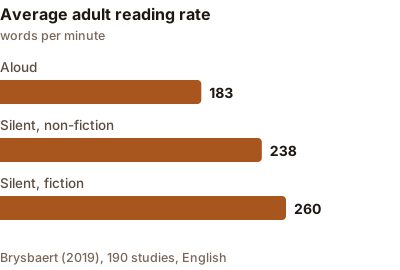
The average adult reads non-fiction silently at about 238 words per minute, and fiction a little faster, at about 260. Those numbers come from Marc Brysbaert's 2019 meta-analysis, which pooled 190 studies and 18,573 participants (Brysbaert, 2019, Journal of Memory and Language).
Reading aloud is slower, at about 183 words per minute. Silent reading wins because your eyes don't have to wait for your mouth.
Where "300 words per minute" comes from
For decades, articles and textbooks put the average at 250 to 300 words per minute. Brysbaert says plainly that his estimates are lower than the figures often cited in scientific and popular writing, and he spends a section of the paper on where those overestimates came from.
If someone promises to triple your reading speed, ask what number they are starting from.
If you read in another language
The 238 figure is for English. Brysbaert shows that rates in other languages can be predicted fairly well from how many words a language needs to say the same thing. A language that packs a sentence into fewer, longer words will score lower in words per minute even when its readers are just as fluent. Compare your result with your own earlier result in the same language, not with an English table.
What the average says about you
Not much. Behind the mean of 18,000 people is a wide spread: most adults read non-fiction at 175 to 300 words per minute and fiction at 200 to 320. Brysbaert notes that these individual differences are reliable and still not well understood.
Your pace also depends on the text. You read a washing machine manual differently from a mortgage agreement, and the mortgage agreement differently from a thriller.
How to measure your own pace
- Pick a text you haven't read, of medium difficulty. A newspaper feature works, a university textbook doesn't.
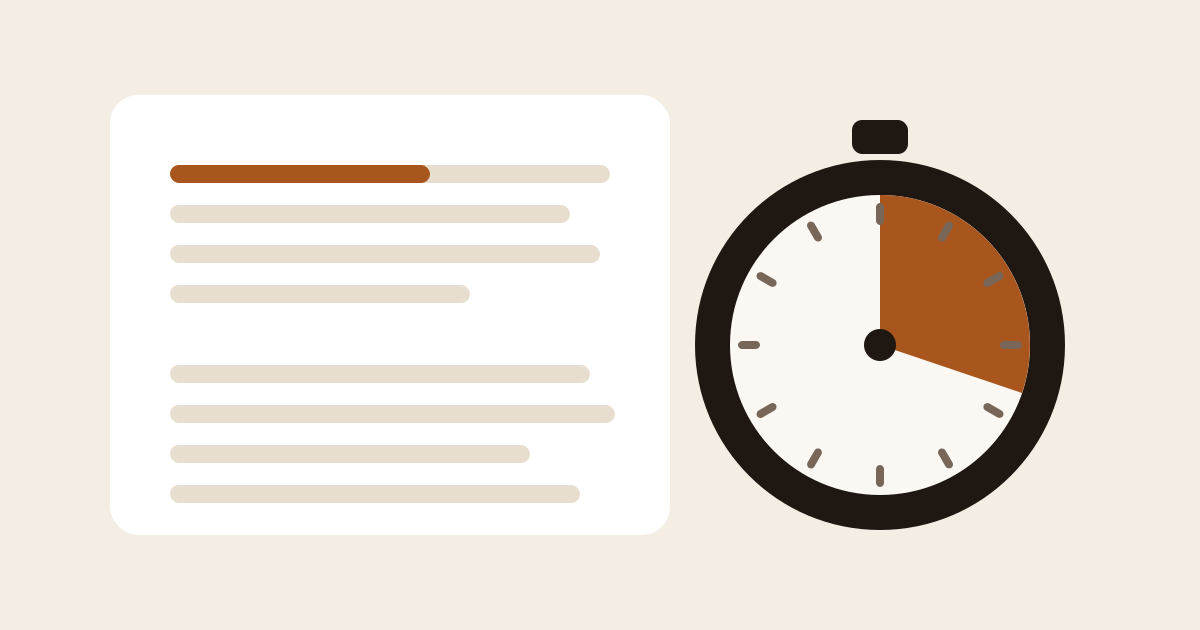
- Read silently for 3 minutes, at your everyday pace. Don't speed up for the test.
- Count the words you read and divide by 3.
- Write down a few sentences about what the text said. If you can't, your number is inflated.
The last step separates reading from moving your eyes along the lines. Eye-movement researchers have shown for a long time that past a certain pace, comprehension drops (Rayner et al., 2016, Psychological Science in the Public Interest). Reading faster only makes sense if you know how much of the text you keep.
What you can improve
Some of the time goes to habits you can spot in yourself: giving every word the same attention, drifting off halfway through a paragraph, and going back over sentences you read without focus. Looking back as such isn't a mistake, as we explain in Does speed reading work? You can work on these habits with short, regular practice and track the effect with the same test every week.
Readspresso starts with exactly that measurement. The first time you open it, you read a short text, answer questions about it, and get your pace together with a comprehension score. Later sessions compare you with that starting point, not with the average from the research.