 Readspresso
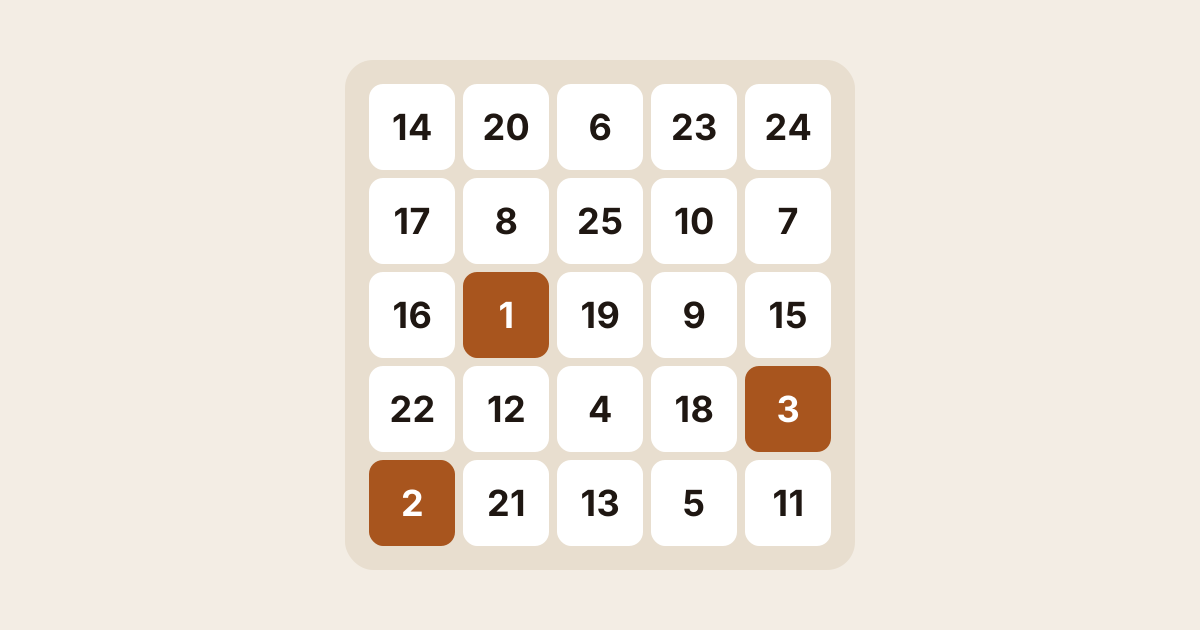
A Schulte table is a 5 by 5 grid with the numbers 1 to 25 in random order. The task is to point to them in sequence, from 1 to 25, as fast as you can, while keeping your eyes on the centre of the grid. It trains visual search and sustained attention. There is no research showing that a better time on the table translates into faster reading.
Where it comes from
The table is named after Walter Schulte (1910–1972), a German psychiatrist. It was designed as a test of attention, and researchers still use it that way. In 2022 a team compared how children aged 8 to 11 searched for numbers in a single-colour table and a two-colour one (Lu et al., 2022, Brain and Behavior). The search took longer when the numbers came in two colours.
Speed-reading courses use the tables too. They are the ones who added the promise of a "wider field of view", which we come back to below.
How to practise, step by step
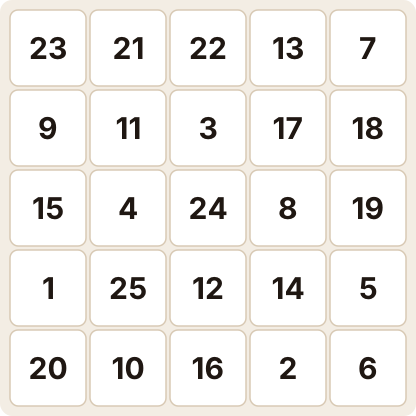
Here is a table you can print or use straight on screen.
- Sit so the whole table fits in view without moving your head. On a phone, holding it in your hand is enough; put a printout flat in front of you.
- Fix your eyes on the centre cell of the table.
- Start a stopwatch and point to or tap the numbers in order, from 1 to 25.
- Write down your time and compare it with your attempts a week from now.
- Do 2 or 3 attempts a day, each on a fresh table.
When 5 by 5 feels smooth you can move to a bigger grid, and if it's too hard, start with 3 by 3 and the numbers 1 to 9. A harder variant is the Schulte-Gorbov table: numbers in two colours, black ones in ascending order and red ones in descending order, alternating.
Common mistakes
Using the same table every day. After a few days you remember where each number sits, and your time improves through memory, not attention. Every attempt should have a new layout, which is why the table above is only good for your first try.
Moving your head. The point is to shift your attention, not your whole body. If you catch yourself turning your head, move the table further away.
Chasing a record at the cost of mistakes. A time without accuracy tells you nothing. Count your mistakes alongside your time, and treat an attempt with several mistakes as a fail. In the app, a round forgives one mistake and fails on the second.
What the table trains, and what it doesn't
A Schulte table trains one specific task. In 2016 Daniel Simons and six co-authors reviewed the studies cited by companies selling "brain training" (Simons et al., 2016, Psychological Science in the Public Interest). They found extensive evidence that practice improves performance on the trained task itself, less evidence that it improves closely related tasks, and little evidence that it carries over to distantly related tasks or to everyday cognition.
Reading is a long way from a grid of numbers. The research on speed reading also shows that the area your eyes take letters from while reading is set by how much language information the text carries, not by how well you see out of the corner of your eye. Drills that flash words in the periphery have not made people read faster with good comprehension (Rayner et al., 2016). There is more on this in Speed reading: what works and what's a myth.
So why practise? Two minutes with the table is a short task that takes your full attention and gives you a number you can track. You can use it as a warm-up before reading, or as a break that pulls you out of distraction. If your goal is to read faster, the table can open a session but shouldn't replace one. According to Rayner's review, the people who read fast with good comprehension are the ones who read a lot, as we explain in Does speed reading work?
The Schulte table in Readspresso
In the app, the number table is part of the free version and comes up in the daily workout. It starts at a 3 by 3 grid and grows to 6 by 6. Every round draws a new layout, so you can't learn the table by heart. Your level, and with it the grid size and time limit, adapts to your results. Readspresso Pro adds a letter table and the Schulte-Gorbov table.
For today: do three attempts on the table above or in the app, write down your best time, and come back to it in a week.